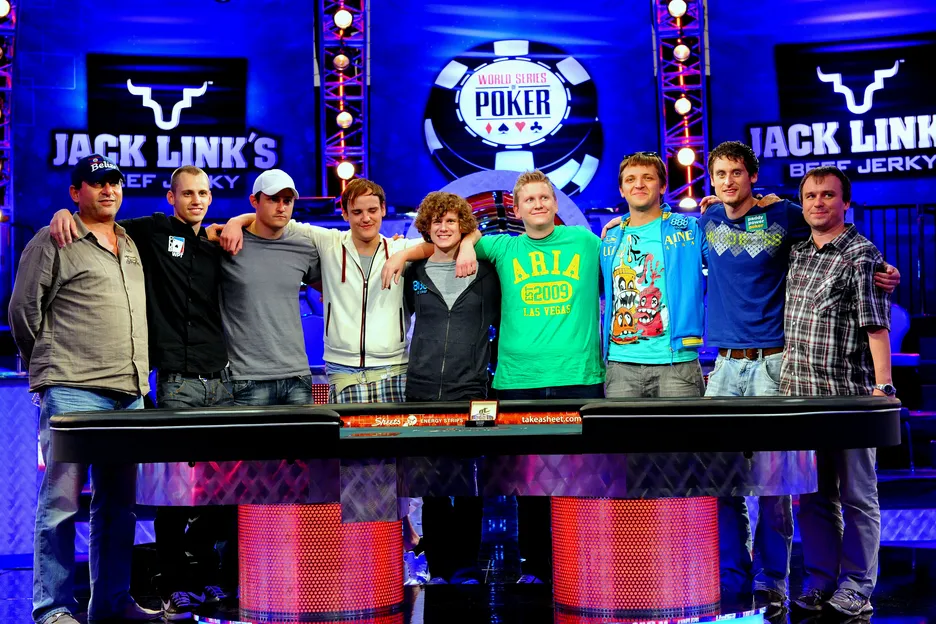
Name: The November Nine
Also known as: Poker’s most famous four-month timeout
Years active: 2008–2016
Look: Nine finalists frozen in time, waiting months to resume play for poker’s most coveted bracelet
If the phrase “Free the November Nine!” rings a bell, you might be mixing it up with the Chicago Seven trial, the Guildford Four, or the Birmingham Six — all infamous courtroom sagas.
This was different. This was poker.
Back in 2008, the WSOP introduced a radical idea: pause the Main Event when it reached nine players, send everyone home for four months, then reconvene in November to play down to a champion. The concept was simple — give ESPN time to edit the earlier action, build suspense, and broadcast the final table to a primetime audience that didn’t already know the outcome.
In theory, it created anticipation. In practice? It created the longest coffee break in tournament history.
A Four-Month Strategy Session
Opinions were mixed.
Ylon Schwartz, a member of the inaugural November Nine in 2008, wasn’t thrilled. He famously argued the delay damaged the tournament’s integrity, saying its “antiquity and purity” had been sacrificed. Schwartz ultimately finished fourth, earning more than $3.7 million.
Others embraced the opportunity.
Dennis Phillips, who placed third that same year, later revealed just how intense the preparation became. He and his team tracked opponents, studied tendencies, and compiled a detailed binder breaking down each finalist’s strategy. With months to prepare, the final table became less a continuation of a tournament and more a high-stakes rematch — with scouting reports.
By the time the format was retired in 2016 following Qui Nguyen’s victory, preparation had reached new levels. Nguyen reportedly trained using poker bots that simulated his opponents’ playing styles.
Was that allowed? Technically, yes. Coaching outside the tournament area wasn’t prohibited. And when millions of dollars are on the line, few players are going to ignore four months of preparation time.
Why It Worked — and Why It Faded
The November Nine made sense in the television era. ESPN wanted viewers to tune in without spoilers, and delaying the finale created a made-for-TV climax.
But poker consumption has changed.
Today, fans are comfortable watching long-form livestreams online. The WSOP now promises extensive daily streaming coverage, and audiences don’t need a four-month buildup to stay engaged. By 2016, the November Nine experiment was shelved.
Or so we thought.
A Curious Omission in 2026
When the 2026 WSOP schedule was released, one detail stood out: the dates for the Main Event final table were missing.
Organizers confirmed there will be a break once the field reaches nine players — but they haven’t said how long it will last.
A short pause? A few days? Or something more reminiscent of the November Nine era?
For players hoping to arrange last-minute coaching sessions, clarity would help. Then again, if history tells us anything, extra time tends to benefit the most prepared competitors.
Do say: “The best things come to those who wait.”
Don’t say: “…that’s what I tell everyone I owe money to.”